

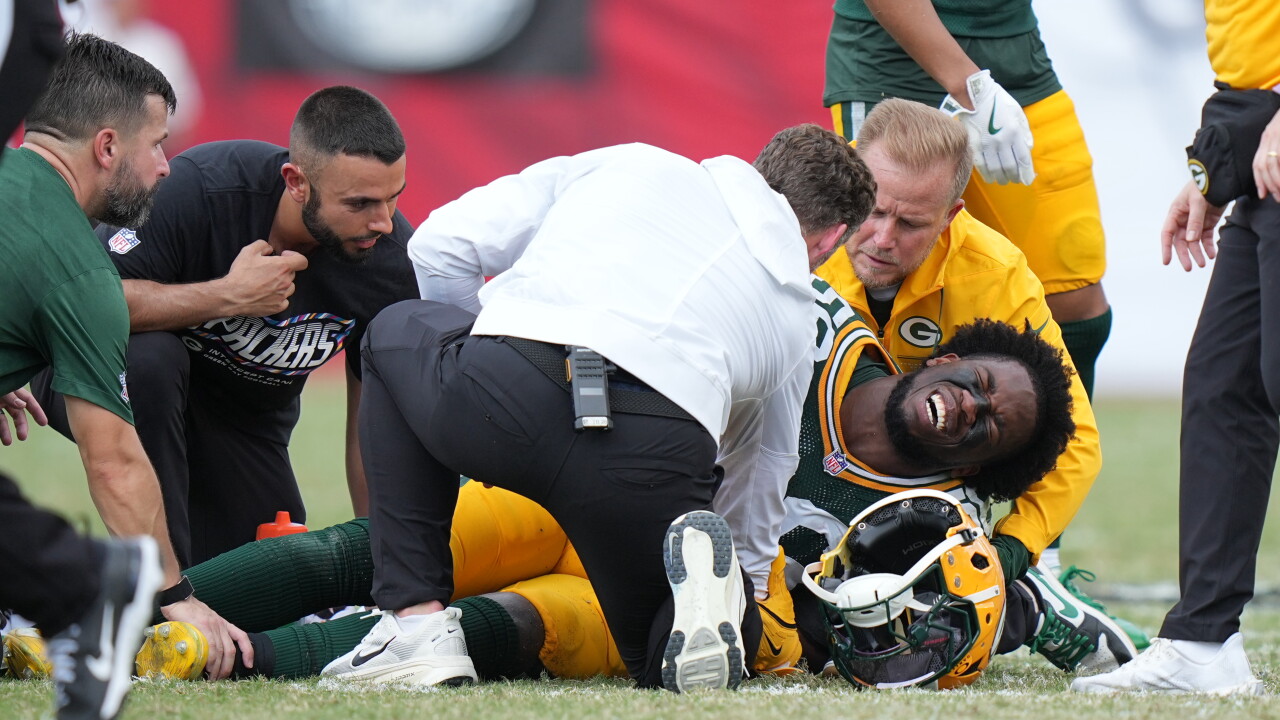


GREEN BAY (NBC 26) — On Sunday, Packers player Edgerrin Cooper tore his Achilles tendon, an injury that medical experts say has become increasingly more common.
- According to research from the International Journal of Sports Physical Therapy, Achilles tendon ruptures have increased between 300-500% over the past few decades.
- There's no clear reason why the injuries are on the rise.
- Physical therapists recommend strengthening the tendon through specialized exercises.
Dr. Matt Buch owns Total Pursuit Physical Therapy and Performance in De Pere.
He says Achilles tendon injuries are one of the most common injuries he treats.
“We’re dealing with this stuff every week," he says.
The Achilles tendon connects the calf muscle with the heel bone. Rupturing the tendon is a severe injury that requires comprehensive treatment and usually surgery.
“Most Achilles tendon ruptures occur via non-contact, meaning it’s not usually during a tackle or somebody being hit," Buch says. "It’s usually just an abrupt change in motion, or a quick acceleration that puts a tremendous amount of stress on the tendon, and eventually it just gets to the point where it overloads what the tendon can actually absorb.”
Dr. Buch says the physical therapy process after an Achilles tendon injury could last longer than a year.
“The recovery process for a full Achilles tendon rupture is going to be fairly extensive," he says. “We need to be cognizant that the entire system needs to be built back up, and we need to be looking at the entire body when we’re doing rehab like that. Not just getting pigeon holed into looking at the tendon itself.”
Watch the broadcast version here:
Dr. Buch says by doing specialized strength exercises targeted at the Achilles tendon- such as heel raises- can help prevent injury.
“Strength and continuing to work the tendon on a consistent basis is going to be your best line of defense," he says.
It’s a common injury in the NFL. The International Journal of Sports Physical Therapy finds that the number of Achilles tears over the past few decades has risen by 300-500%.
The reason for the increase isn’t clear, but the IJSPT research offers a few theories, including an increase in BMI of players and rubberized turf instead of natural grass.
The Packers were playing on natural grass when Cooper was injured.
“I don’t think we have conclusive, definitive evidence as to why we’re seeing many more," Dr. Hui Zhang, an orthopedic surgeon at Aurora Health Care, says.
Dr. Zhang says recovery is typically 6 months for athletes.
“Oftentimes even though we call it a season-ending injury, oftentimes they’re not career-ending injuries, because they can and often do bounce back well after having surgical treatment," he says.
Dr. Zhang says the injury is common for "weekend warriors," which is a term given to someone who does relatively nothing during the week, then participates in an intense workout or physical sport on the weekend. He says stretching and warming up before any physical activity can help reduce the risk of injury.
“Not everyone has to have surgery, and that’s why if you have an injury like this, I encourage you to talk to your orthopedic surgeon," he says.
