

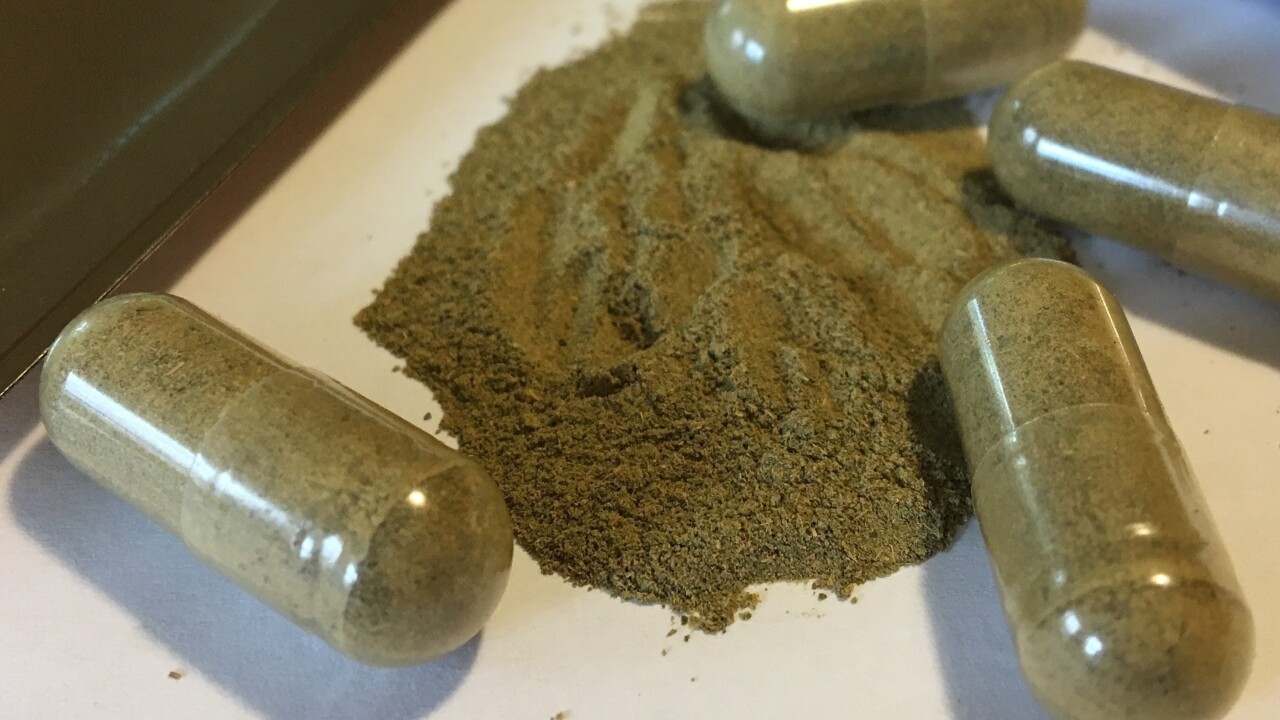


The Mishicot police department is warning neighbors of kratom and concentrated 7-OH, saying the substances are something parents and community members should be aware of.
Kratom is a substance that comes from the leaves of a tree native to Southeast Asia. At low doses, users report feeling more alert and energized. At higher doses, it can have pain-relieving effects.
Watch the full broadcast here:
Mac Haddow, senior fellow on public policy with the American Kratom Association, says the biggest concern isn't just kratom — it's the concentrated and synthetic products being sold as kratom. That includes 7-OH, or 7-hydroxymitragynine, a compound found naturally in small amounts in the kratom plant.
"The natural kratom plant has very specific effects that are beneficial to the health and well being of it's consumers," Haddow said. "These synthesized versions which are engineered deliberately to be full blown opioids are not kratom."
These products can come in powders, capsules, gummies, and liquid shots.
"It gives you a fast euphoric high like a signature opioid within a couple of hours," Haddow said. "It lasts for about 2 and a half to 3 hours, then you crash, then you crave it."
Jerry Halverson, Rogers Behavioral Health CMO, says he tends to see patients who use kratom in addition to other substances experiencing withdrawal.
"I think the labeling isn't clear," Halverson said. "You find this in some CBD products, a lot of things you buy off the street, you don't quite know what you're getting."
"You hear 'hey, this is natural this is not going to cause you any problems' and there are people that are able to use it and not have any issues, just like some people can use alcohol and not have issues," Halverson said.
The Medical College of Wisconsin says kratom exposures reported to America's Poison Centers jumped from 19 cases in 2010 to over 1,200 in 2023.
"There isn't really great evidence that it is good for anxiety or good for sedation in most people," Halverson said. "So the risks, which are real, as far as we are concerned, will outweigh the benefits."
Wisconsin classifies kratom and 7-OH as Schedule One controlled substances, making it illegal to possess, sell, or distribute. Meanwhile, the American Kratom Association says it wants regulation of synthetic products, not a ban on natural kratom.
This story was reported on-air by a journalist and has been converted to this platform with the assistance of AI. Our editorial team verifies all reporting on all platforms for fairness and accuracy.
